Sambuichi Peofessional Engineers Office
-

Hierarchical Tidy Data: A Comprehensive Solution for Multi-layer Data Structures
Views: 13 Hierarchical Tidy Data: A Comprehensive Solution for Multi-layer Data Structures Table of Contents 1. Introduction 2. Original Journal Entry 3. Nearly Tidy Data 4. Hierarchical Tidy Data 5. Conclusion 6. Dialogues with ChatGPT Nobuyuki SAMBUICHI ISO/TC295 Audit data services/SG1 Semantic model Convener Following texts are produced by ChatGPT and edited by me. ChatGPT said “As an AI language model, I don’t have feelings or opinions. However, based on our interaction, I hope I’ve been able to provide clear and helpful responses to your questions. We’ve discussed several complex topics, including the principles of tidy data, the challenges of applying these principles to hierarchical data structures, and how hierarchical […]
-

XBRL-GL for Audit Data Collection
Views: 4 XBRL-GL for Audit data collection Table of Contents 1. Mapping between ADC, ADS and XBRL-GL 1.1. Mapping table 1.2. What is the European Triangular currency? 1.3. Bookkeepping in the subsidiary 2. Example instance document 2.1. Sample Journal entries file for XBRL Global Ledger Framework with annotations Version 1.0.91021.1 2.2. Sample Journal entries with timing differences file for XBRL Global Ledger Framework with annotations Version 1.0.91021.1 Nobuyuki SAMBUICHI ISO/TC295 Audit data services/SG1 Semantic model Convener The AICPA (American Institute of Certified Public Accountants) has established a way to connect specific fields in a standard table file with elements in an XML format called XBRL-GL. This is done to facilitate […]
-

Achieving Data Consistency and Clarity in the Table Structure
Views: 11 Achieving Data Consistency and Clarity in the Table Structure Table of Contents 1. Refine Trial Balance Table 2. Missing 4 currency codes 3. How to find out functional currency code? 4. 4 currency codes 5. No.2,3,5 were not improved with your solution Nobuyuki SAMBUICHI ISO/TC295 Audit data services/SG1 Semantic model Convener I recommend the result for 4 currency codes, but it is important in designing a semantic data model to understand what kind of results will be achieved if the model is designed on the premise of normalization. 1. Refine Trial Balance Table User Can you point out the problems with following table definition? PK means the primary […]
-

Shifting Towards Simplicity: Using Single Unique Identifiers in Our Data Model
Views: 11 Shifting Towards Simplicity: Using Single Unique Identifiers in Our Data Model Nobuyuki SAMBUICHI ISO/TC295 Audit data services/SG1 Semantic model Convener In our current table and field definitions, we have several tables that define their primary key as a combination of multiple fields. I recommend that we use a single primary key to define our object classes from our table definition. Primary keys and referenced identifiers (foreign keys) should be defined more simply and clearly in UML associations. User Provide some pros and cons of defining a primary key on multiple fields. Provide the advantage of designing the semantic model of object classes using a single unique identifier (primary […]
-

Extend existing standard or develop our own standard from scratch
Views: 7 Extend existing standard or develop our own standard from scratch Nobuyuki SAMBUICHI ISO/TC295 Audit data services/SG1 Semantic model Convener Model: Default (GPT-3.5) User Is it allowed to extend existiong iso standard to draft new iso standard? ChatGPT Yes, it is possible to extend an existing ISO (International Organization for Standardization) standard to draft a new ISO standard. ISO standards are developed and maintained by technical committees and working groups composed of experts from various industries and organizations. When a need arises to address additional aspects or areas related to an existing ISO standard, a new standard can be developed as an extension or revision of the original standard. […]
-

Knowledge Graph RDF/OWL and XBRL
Views: 4 Knowledge Graph RDF/OWL and XBRL Model: GPT-4 (Mobile, V2) ChatGPT may produce inaccurate information about people, places, or facts. ChatGPT May 24 Version NOTE I’m not familiar with RDF/OWL and the answers given by ChatGPT have not been verified. User What is knowledge graph? ChatGPT A knowledge graph is a method of storing data that enables information to be interconnected in a way that models the relationships between entities in a more human-like manner. It organizes data points into entities (or “nodes”) and describes their relationships (or “edges”) in a graph structure. For example, in a knowledge graph, “Paris” might be a node connected to “France” via the […]
-

Why ISO Needs a Framework
Views: 17We cannot allow arbitrary schema definitions. ISO DP2 requires a framework for use by prospective qualified people so that experts can verify that future developments and/or extensions are conformant with the provisions provided in the standard. There is no international standard that has not defined a framework. The data elements and usage may change by jurisdictions and auditors but how to specify requirements on data items shall be provided as a framework.The development of an audit data service standard requires an audit data service semantic model framework. We cannot allow arbitrary schema definitions. It is essential to have a framework on which to determine whether the defined schema is […]
-

A tidy data approach for digital ledgers
Views: 13 A tidy data approach for digital ledgers General Ledger journal entry Consider how to define tidy data for General Ledger journal entry. The following is a journal entry example for purchasing paper with cash. Table 1. General Ledger journal entry Date Line Description Debit (JPY) Credit (JPY) Account Number Account Name C N T ID 2009-04-03 用紙 paper 14,858 754 事務用消耗品費 Office consumables expenses 10 札幌 Sapporo 部門 Business unit 943-8-477 2009-04-03 742 191 仮払消費税等 Temporary payment consumption tax 10 札幌 Sapporo 部門 Business unit 943-8-477 2009-04-03 用紙 paper 15,600 111 現金 Cash 0 共通部門 Common department 部門 Business unit 943-8-477 Key C: Business Segment Code, N: Business […]
-

Can schematron validation rules from JP PINT 0.9.2 make your validation Compliant?
Views: 10Peppol authority of Japan announced new releaseJP PINT 0.9.2 . PINT Complience states; Senders compliance to PINT based BIS A sending party may claim compliance to the Peppol International model if they send invoices that comply with the rules of the Peppol International Invoice when applied without any specialized rules even if that document may at the same time comply with any set of specialized rules. Processing of rules A sender SHALL NOT send messages that are not compliant to the BIS specification identified by the customization. A sender shall validate an outgoing message that are in line with the customsation identifier. I would like to compare this version […]
-

Pool/template rules with abstract Schematron
Views: 15Comment from Mr. Oriol Bausà on 2022-02-27. There was an additional idea behind this architecture: the possibility to use different syntaxes to implement the same rules. In the EN, this was a must, as the EN shall be implemented in UBL and CII (at a certain point, there was an EDI implementation as well). So the rules are defined by business experts in natural prose. And the Schematron experts shall implement the XPath expressions to support the requirements expressed in the text rules. CEF’s GitHub EN16931 Validation artifacts v.1.3.2 is maintained by Oriol and these files have interesting characteristics by defining abstract business rule definition and schematron implementation. Directory […]
-
PoC: e-Invoice and XBRL
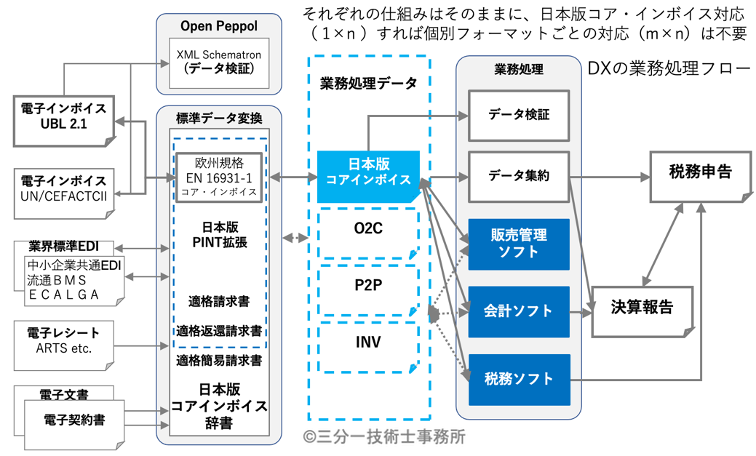
Introducing Open Peppol simply add a new EDI to the existing EDI, and said, “It has become a” technical debt “with soaring maintenance and operating costs, and we cannot repay it. It is feared that DX’s obstacles of “not allocating funds and human resources to strategic IT investment (a hindrance to DX promotion)” (Ministry of Economy, Trade and Industry) will remain.
-

ISO/TC 295 Audit data services Business Requirement
Views: 11Reduce, Reuse and Recycle is the key concept of SDGs Avoid Not-invented-here syndrome (NIH). NIH can be defined by a tendency for people and organizations to avoid things that they didn’t create themselves. This syndrome is similar to the “let’s reinvent the wheel” syndrome. [SOURCE: https://www.bmc.com/blogs/not-invented-here-syndrome/ ] Business Process Now that we have extended the TC name to audit data services, we should support not only data modeling but also business processes, business rules, and these validation. Extensibility Organizations in each jurisdiction have regulations and / or internal control rules for each jurisdiction. We SHALL supports extensibility to meet these requirements. Comparability There are many things in common other […]
Got any book recommendations?

