
Views: 0
Why XBRL Tavi Was Created and the World Beyond It That XBRL GL Opens Up
2026-11-25
XBRL made financial reporting machine-readable. Yet even when reports can be expressed in CSV or JSON, the taxonomies that define their meaning retain the complexity of XML Schema and XLink. Project Tavi, whose first Public Working Draft was published in September 2026, seeks to redesign this part of the system. Its purpose is not to discard existing XBRL altogether, but to preserve its strengths in financial reporting, extend its application to events, journal entries and reference data, and make its rules easier for both humans and AI to understand. Hierarchical business data can already be represented as Structured Tidy Data using the combination of existing XBRL 2.1, XBRL Dimensions and xBRL-CSV. Tavi is expected to simplify semantic definition and validation while retaining this expressive capability. This article examines progress and outstanding challenges through the official Requirements and PWD, examples of xBRL-CSV adoption and experiments in XBRL GL Next.
1. From a financial reporting standard to a standard for diverse business data
The value of XBRL lies not merely in digitising numbers. Through taxonomies containing Concepts, Dimensions, data types, labels, relationships and validation rules, it enables machines to process the meaning of data.
However, XBRL 2.1 taxonomies have been built around XML Schema and XLink. Although xBRL-CSV and xBRL-JSON have modernised report input and output, understanding the underlying definitions still requires specialist knowledge and familiarity with several specifications.
The XBRL Taxonomy Model Requirements 1.0 of 17 December 2025 sets out the requirements for an OIM Taxonomy intended to change this. Whereas the initial OIM (Open Information Model) separated reports from their syntax, the next stage redesigns the taxonomy functionality itself. As its scope expanded to encompass both taxonomies and reports, the initiative became known as Project Tavi. [1], [3]
1.1. Three layers of objectives for the new standard
To understand this development, it is useful to distinguish format, semantic model and operational constraints. Traditional XBRL has evolved around XML documents representing reports, taxonomies specifying what may be reported, and several linkbases addressing calculation, presentation and validation. Although taxonomy concept names and report values can be separated, discovering their meaning requires navigating specifications such as XML Schema, XLink and Dimensions.
The first stage of OIM defined the XBRL reports within its scope as a syntax-independent Fact model. Within that scope, representation and conversion between xBRL-XML, xBRL-CSV and xBRL-JSON became possible. Some structures, such as XBRL 2.1 Tuples, are not directly supported by the current OIM. Meanwhile, Concepts, dimensional definitions, relationships and constraints underlying reports depend on existing XBRL taxonomies. Adopting CSV does not mean that taxonomy loading and interpretation can be accomplished using CSV alone.
The second stage, OIM Taxonomy Requirements, revisits the definition framework itself. Its goal is to express Concepts, the association of Dimensions with Cubes, and relationships in Networks through a more direct information model. Project Tavi proposes a concrete model and JSON representation in response to these requirements.
At the third stage, the market needs implementable validation, exchange and integration. High-quality data collection requires more than defining semantics: missing values, duplicates, inconsistent references and calculation discrepancies must actually be handled. When assessing Tavi’s maturity, we must distinguish what can be declared in JSON, what processors can interpret, and whether different processors produce the same validation results.
| Subject | Role | Important boundary |
|---|---|---|
|
OIM Report Model |
Describes Facts independently of syntax |
Does not redesign the entire taxonomy |
|
xBRL-CSV |
Exchanges OIM Facts using tabular data and metadata |
JSON metadata is the report entry point |
|
OIM Taxonomy Requirements |
Lists functionality required of next-generation taxonomies |
Not a specific JSON design or implementation test result |
|
Project Tavi PWD |
Proposes a unified model and its components |
A public working draft, not a completed standard |
|
XBRL GL Next PoC |
Materialises and compares hierarchical records |
Does not signify approval by a standards organisation |
2. What has the market been asking for?
Behind this development are needs that go beyond a simple change of format from XML to JSON.
* Handling larger volumes of more detailed data. Financial supervisory data collection requires efficient exchange of granular information and large numbers of records, not just aggregate values.
* Integrating definition and validation. Filing rules dispersed across Filing Manuals and external rule files should move towards declarative constraints that machines can use directly.
* Making taxonomies easier to use. Semantic information should be accessible not only to specialist XBRL processors, but also to general developers, data analytics tools and AI.
* Simplifying extension and reuse. Components common to multiple reporting regimes should be reusable without unnecessary complexity.
XBRL International’s official explanation identifies six objectives: ease of use, AI enablement, understandability, performance, consistency of modelling and improved declarative constraints. [4]
2.1. xBRL-CSV is already used in actual reporting
The European Banking Authority (EBA) provides a concrete example of market demand. Under the published policy for EBA Reporting Framework 4.2, submissions and resubmissions for reference dates on or after 31 March 2026 generally use xBRL-CSV. Transitional arrangements permit both xBRL-XML and xBRL-CSV for earlier reference dates. New reporting types for MiCA, Pillar 3, Instant Payment and DORA use CSV regardless of reference date. [7]
The EBA is also advancing its semantic model through DPM 2.0. This demonstrates a real need for large-scale tabular regulatory reporting and management of its underlying semantic definitions and validation.
However, the EBA’s adoption of xBRL-CSV does not mean that it has decided to adopt Tavi. The experience with xBRL-CSV provides important evidence for understanding Tavi’s background, but the two adoption decisions must be distinguished.
Even with simple CSV, metadata referencing the Taxonomy Entry Point and mappings to Concept, Unit, Entity, Period and Dimension remain essential. A column named amount, for example, does not reveal whether it represents sales or a debit amount, its currency or its occurrence scope. Tavi is expected to simplify these semantic definitions.
2.2. Validation rules do not reside entirely within the taxonomy
In reporting regimes, syntactic validity alone does not establish that a submission is acceptable. Correlations between items, regime-specific mandatory items, monetary aggregation, appropriate periods and entities, and identifier references must also be considered. Some of these rules have traditionally been distributed across XBRL Formula, Calculation, Filing Manuals and validation plug-ins. Consequently, the meaning of a pass may vary with the versions and combinations of validation resources used.
The Declarative Constraints objective in the OIM Taxonomy Requirements aims to make at least simple, common rules machine-readable in a more manageable structure. Reproducing the entire existing Formula grammar in new JSON is not the only solution.
Rules such as requiring a Unit for a monetary Concept, disallowing a particular Dimension in a Cube, or requiring a value at a Fact Position can be stated declaratively when their subjects and logic are clear. Conversely, aggregating multiple records and reconciling results by tax rate requires explicit scope, calculation methods, rounding and treatment of missing values. Simple Cube definitions should not be equated with complex business calculations.
2.3. Adding third-party validation rules
Add-on Bundles addressed by REQ-EXT005–007 reflect a demand to select and apply third-party Data Quality Rules as well as Labels and References. Traditional Formula resources are discovered through a DTS; when third parties assemble additional rules at a report user’s discretion, the relationship to the taxonomy discovery scope becomes an issue.
For Add-on Bundles, three levels must be distinguished: third parties can distribute additional resources, the same logic as existing Formula can be expressed, and the same input produces the same validation results. Requirements for Bundles do not establish that the current PWD achieves equivalence with Formula 1.0 as a whole. [1], [2]
3. Is it fully compatible? Not unconditionally
REQ-GEN002-Completeness requires functionality equivalent to commonly used XBRL 2.1 features consistent with current best practice. It explicitly does not require reproducing everything possible in the XML syntax of XBRL 2.1.
REQ-GEN004-BackwardsCompatibility requires that existing taxonomies within scope can be converted to the new model, whilst allowing configuration and mapping to be necessary. This does not mean that all existing files will work unchanged or that fully automated round-trip conversion is guaranteed.
XBRL International explains that existing XBRL 2.1 specifications will not be discontinued and no migration deadline will be imposed. [5]
Tavi therefore seeks not a complete copy of syntax, but to carry forward the semantics and functionality in use through the new model, extending them where needed.
3.1. Four kinds of compatibility
The relationship between XBRL 2.1 and Tavi cannot be reduced to a binary choice between compatible and incompatible. At least four kinds should be distinguished.
| Compatibility | Question to examine | Current understanding |
|---|---|---|
|
Syntactic compatibility |
Can existing XML Schema and XLink be used unchanged? |
Not Tavi’s objective |
|
Functional equivalence of models |
Can important semantics of Concepts, Dimensions, Networks and Calculation be retained? |
REQ-GEN002 requires this within a defined scope |
|
Taxonomy migration capability |
Can existing taxonomies be converted to the new model? |
Required by REQ-GEN004, allowing configuration and mapping |
|
Semantic equivalence of instances |
Can the same data be interpreted as the same Facts after conversion? |
Requires specific conversion rules and comparative validation |
Even if the same Concept QName and amount remain, report validity may change if conversion loses dimensional constraints imposed by the original Definition Network. Conversely, even if XML hierarchies differ, business equivalence may hold where meaning, Dimensions, calculations and identity are preserved.
One-way conversion and fully reversible round-trip conversion are different things. If XML-specific information with no counterpart in the new model is removed, complete restoration of the original technical document becomes difficult. Evaluating backwards compatibility requires identifying what is preserved and what falls outside the conversion scope.
3.2. Existing functionality referenced by REQ-GEN002
In addition to core XBRL 2.1 functionality, the Requirements cover Dimensions 1.0, Extensible Enumerations, Generic Links, Labels and References, Calculation 1.1 and related features. This does not require unconditional reproduction of every representation method or extension. Preserving the business meaning of the functionality within scope is a more appropriate description than retaining the representation syntax.
| Existing functionality | Candidate new structure | Checks needed for evaluation |
|---|---|---|
|
Item / Fact |
Concept and Fact |
Agreement of value, type, Entity, Period and Unit |
|
XBRL Dimensions |
Cube / Dimension / Domain |
Agreement of effective and prohibited Dimensions |
|
Presentation / Generic Links |
Network / Relationship |
Relationship type, scope and order |
|
Extensible Enumerations |
Domain / Member, etc. |
Permitted values, extensions and legacy values |
|
Calculation 1.1 |
Successor design for calculation and reconciliation relationships |
Scope, Weight and validation results |
|
Generic Labels / References |
Label / Reference |
Language, reference target, authority and extension method |
|
Tuple hierarchy |
Record structure using Cubes and occurrence Dimensions |
Preservation of parent-child occurrences and required Facts |
The current PWD contains many corresponding components. However, the existence of components with corresponding names does not demonstrate complete operational compatibility. In particular, completion of Calculation 1.1-equivalent functionality, migration converters and comprehensive conformance tests cannot be established from the published materials. [1], [2]
3.3. Important considerations in migration design
Migration validation cannot merely count whether the same Concepts remain after rewriting a model in new JSON. Differences in original Networks, dimensional constraints, Labels, References, Datatypes, expressions, validation rules and scopes applicable to each Entry Point must be understood.
Source taxonomies may contain standard shared components, organisation-specific Extensions and externally maintained validation resources. Conversion may therefore require reconstructing a collection of interdependent definitions rather than replacing a single file.
Nor should functionality outside the specified scope automatically be considered expendable. Practical migration decisions require separate explanations of whether functionality falls within REQ-GEN002, whether it is essential to current operations, and whether alternatives exist.
4. How far has the PWD progressed?
Project Tavi 1.0 of 1 September 2026 is a Public Working Draft (PWD). It describes model structures such as Concept, Dimension, Cube, Network, Relationship, Property, Label, Reference and Import, together with their JSON representation. Cubes can specify applicable Dimensions directly through cubeDimensions. Reproducing xbrldt:targetRole from the traditional XBRL Dimensions Definition Linkbase in its original syntax is not mandatory.
The PWD is not a final specification. XBRL International does not recommend production use and identifies incomplete clauses. A mechanism equivalent to Calculation 1.1 is intended to be elaborated in future drafts. Defining a model in JSON is distinct from completing all calculation, conversion and validation functionality. [2]
On 10 September 2026, xBRL-CSV Table Constraints 1.0 became a Recommendation on the existing OIM side. It adds validation rules to existing xBRL-CSV metadata, enabling efficient checks before loading taxonomies or constructing the OIM model. In addition to column mandatory status, type and value constraints, tc:keys in §4.7 supports compound key uniqueness (unique) and reference keys (reference). A reference key can reference a unique key in the same or another Table Template. This does not mean that all conditional constraints for heterogeneous hierarchical records in one table or arbitrary business calculations can automatically be defined. Tavi’s challenge is to clarify how such tabular validation functionality relates to its new semantic model. [8]
4.1. Distinguishing levels of implementation in the PWD
When discussing specification progress, it is important not to confuse five stages: specified as a Requirement, vocabulary available in the JSON model, constraints on values defined, actually validated by a processor, and agreement across multiple processors. The PWD partially demonstrates the first three stages; it does not guarantee all of the fourth and fifth.
| Area | Structures described in the PWD | Unconfirmed matters |
|---|---|---|
|
Basic information model |
Concept, Cube, Dimension, Network, Property, etc. |
Completion and compatible processing of the entire specification |
|
Module reuse |
Import, selective references, extension restrictions |
Completeness of arbitrary third-party Rule Bundles |
|
Basic constraints |
Cube and Dimension constraints, Required Cube |
Completeness of general cross-record constraints |
|
Record Cube Types |
Event, Event Details, Journal, Reference, Position, Time-series, etc. |
Full validation implementation for each Type |
|
Calculation and reconciliation |
Direction of related calculation and aggregation |
Completion of Calculation 1.1-equivalent functionality |
|
Migration of existing taxonomies |
Common components and functional equivalence objectives |
Conversion rules and validation for all features within scope |
At the same time, the maturity of existing xBRL-CSV Recommendations and validation specifications must not be attributed to the Tavi PWD itself. Validation of published review JSON against a Draft-07 Schema does not prove that Tavi-specific semantics or Fact reconstruction are correct.
4.2. Boundaries between Formula, Calculation and Table Constraints
In financial reporting, the same word, validation, often refers to different technologies. Calculation addresses aggregation and reconciliation relationships between numeric Facts; Formula can express a broad range of Assertions involving conditions and variable selection. xBRL-CSV Table Constraints addresses constraints relating to tabular data and Templates. Cube Constraints addresses rules for Dimensions and the Fact space applicable to a Cube.
There is no need to force every aspect of meaning into one technology. Validation results are easier to explain when structural validity, Fact existence constraints, computational consistency and conditional business rules are distinguished.
Consider invoice taxable amounts and tax amounts by tax rate. Selecting lines according to tax category and rate, summing corresponding line amounts, applying rounding rules and comparing against reported tax amounts are distinct stages. Merely placing monetary Concepts and a tax rate Dimension in a Cube does not automate all calculation and validation. A future calculation specification needs rules that identify the subject mechanically and ensure consistent interpretation across implementations. [2], [8]
5. The direction indicated by four representative Cube Types
Tavi proposes Cube Types for record-based data as well as traditional financial reporting. Here we compare reportCube, eventCube, eventDetailsCube and journalCube. The formal name is eventDetailsCube (Details is plural).
| Cube Type | Subject | How Facts are distinguished | Main constraints in the PWD |
|---|---|---|---|
|
|
Traditional financial and business reporting |
Concept, Period, Entity, Unit and additional Dimensions as needed |
Uses ordinary Core Dimensions |
|
|
Individual events |
Typed Dimension representing the Event Key |
Concept and one Event Dimension; event timestamp specified through a relationship to another Concept |
|
|
Multiple details belonging to an event |
Identification of Event Detail occurrences |
Requires a Typed Dimension and relationship to the Event |
|
|
Journal entries and journal lines |
Envisaged as a specialisation of Event Details |
Adds monetary Concept, aggregation and journal Entity mappings, etc. |
5.1. Distinguishing reportCube from record-based Cubes
The term Cube covers several roles. Corporate financial reporting Facts are identified by reporting Entity, Period, Concept, Unit and relevant analytical axes. Events and journal entries, on the other hand, require identification of individual occurrences and handling of multiple data items within them.
Tavi seeks to make this distinction explicit through Cube Types. reportCube focuses on continuity with the traditional reporting model, eventCube and eventDetailsCube handle individual events and repeating details, and journalCube adds accounting-specific characteristics.
| Subject | Main identity | Essential validation question |
|---|---|---|
|
Ordinary financial reporting |
Concept, period, entity and relevant Dimensions |
Does an appropriate Fact Position exist? |
|
Event |
Distinct occurrences even at the same time |
Are Event Keys missing or conflicting? |
|
Event Details |
Details belonging to an occurrence |
Does the corresponding parent Event exist? |
|
Journal |
Journal entries, lines and amounts, etc. |
Is the scope of debit/credit, reconciliation and monetary aggregation correct? |
The following sections distinguish what the PWD states from what may be expected in practice from its definitions.
5.2. reportCube — carrying forward traditional XBRL
xbrl:reportCube is a Cube Type representing the Fact space of traditional financial reporting. PWD §14.5.1 lists xbrl:concept, xbrl:period, xbrl:unit, xbrl:entity and xbrl:language as Core Dimensions. It carries forward the familiar approach of selecting financial statement items by Concept and combining period, reporting entity, unit and other analytical axes.
5.2.1. The bridging role of reportCube
In traditional financial statements, a Concept such as revenue for the current period is identified by reporting entity, period and Unit. Additional Dimensions may distinguish business segments, regions, consolidated and separate statements. This is one of the most important patterns established by XBRL, and it needs to remain semantically expressible in the new model.
reportCube is intended to carry traditional strengths into the next-generation model, rather than sacrificing financial reporting for new record-based processing. It does not guarantee equivalence through automatic migration for all existing Presentation and Calculation usage patterns.
A simple set of Cube Dimensions is also distinct from a reporting regime rule requiring a particular value under specified conditions. Tavi’s functional equivalence must be evaluated at both levels.
5.3. eventCube — identifying events independently of their timestamp
xbrla:eventCube assigns a Typed Dimension to identify events. PWD §15.4.1 requires one Typed Dimension serving as an Event Key in addition to Concept. The event timestamp is not the key itself, but is specified through an xbrl:concept-refDimension relationship between a timestamp Concept and the Period Dimension. This does not mean that a Period Dimension is added directly to the Event Cube.
This enables different events occurring at the same time to be distinguished. However, having an xs:token key alone does not validate all business duplicates or referential integrity.
5.3.1. eventCube identifiers and timestamps
Identification based solely on timestamps cannot distinguish multiple events occurring simultaneously. Several measurements may be taken within the same second in a factory, for example, with different meanings or sources despite identical timestamps. Bank transaction events may likewise include multiple contracts or operations at one time.
An Event Key is therefore a reasonable design. The key distinguishes record occurrences, whilst the timestamp is information reported about the event. In other words, period is not forced to serve as a substitute for the event’s UUID.
Tavi Event Cubes use Concept and a Typed Dimension. UUIDs may be used to generate Event Keys in applications, but this does not mean that the PWD mandates a specific UUID version for all events.
An Event Key may be a prerequisite for referring to that Event from other data. Actual validation still needs to establish whether references exist, whether their targets are correct and whether keys are semantically consistent. Expressibility of identity should not be confused with business referential integrity.
5.4. eventDetailsCube — repeating details beneath an event
xbrla:eventDetailsCube represents multiple Details corresponding to one Event. PWD §15.4.2 requires a Typed Dimension identifying the detail and an xbrl:concept-refDimension relationship indicating which event the detail relates to.
The key point is not to confuse identification of the detail itself with reference to its parent event. When the relationship between the parent Event Key and detail key is correctly defined, details belonging to an event can be selected. How far uniqueness and existence can be verified declaratively is a separate evaluation question.
5.4.1. Tavi’s reference-based model versus GL Next’s hierarchical model
The PWD’s standard Event Details Cube uses the Concept Dimension and one Typed Dimension identifying details, and references the parent Event. In contrast, XBRL GL Next, described below, accumulates ancestor Occurrence Dimensions and identifies details through a compound key including the parent Scope. The latter distinguishes the same detail number beneath different parents. This does not mean the standard Tavi Event Details Cube specifies the same compound-key approach.
Referential integrity, mandatory status and uniqueness in both approaches need to be evaluated against both the Requirements and specific constraints.
5.5. journalCube — record-based journal entries
xbrla:journalCube is proposed in PWD §15.4.3 as a type of Event Details Cube. It identifies monetary Concepts for journal lines and specifies aggregation using xbrl:concept-aggDimension and sum. The PWD’s zero-sum constraint should be distinguished from GL Next’s debit-credit balancing using independent debit/credit indicators and amounts. For example, if a debit of 1000 and a credit of 1000 are mapped to signed amounts, +1000 and -1000 sum to zero. This is an illustration, not an approved Binding or automatic conversion rule for negative amounts. Relationships to the journal Entity and Concepts are also handled through Networks.
However, baseCubeType in this clause is written as xbrl:eventDetailsCube, whose prefix differs from the xbrla:eventDetailsCube defined immediately before it. This is a notation requiring clarification in the specification, not something to correct independently. Nor does the Journal Cube proposal establish completion of a successor to Calculation 1.1.
These four Cubes illustrate a direction towards distinguishing models according to the nature of the data rather than syntax. The PWD also proposes Cube Types such as Reference, Time Series and Position.
6. Why not adopt Tuples directly in JSON?
JSON offers Objects and Arrays, making it straightforward to nest multiple Details in a Header. Representing hierarchical business data such as journals, invoices and product component structures in JSON is not inherently difficult. The explanation that Tavi uses Cubes because JSON cannot support Tuples is therefore incorrect.
We need to compare three things: JSON nesting, the XBRL 2.1 Tuple as a standards concept, and the OIM Fact/Dimension model.
6.1. JSON nesting and XBRL Tuples are different
The following JSON is a natural representation of ordinary record data. It does not constitute a Tavi-compliant Instance.
{
  "journal": {
    "entryId": "JE001",
    "details": [
      {"lineNumber": 1, "account": "Cash", "amount": 1000},
      {"lineNumber": 2, "account": "Sales", "amount": 1000}
    ]
  }
}
Although this is readily understood by people, how each value’s Concept, Entity, Period, Unit and Dimensions are treated within a common XBRL Fact model needs separate specification. JSON Schema can describe Object and Array types and required properties, but does not by itself determine the entirety of XBRL Fact Identity, cross-record references, uniqueness and aggregation rules.
XBRL 2.1 Tuples use XML nesting and the XML Schema Content Model to combine Items and structural elements in one document. Repetition within Tuples obtains an implicit occurrence scope through its nested location. This structure has the advantage of expressing Header/Detail intuitively.
By contrast, XBRL Dimensions Facts are identified by combinations of Concept, Context, applicable Dimensions and related aspects. Making both Tuples and Dimensions central Fact mechanisms may duplicate interpretation of occurrence identity, calculations and references. This concern helps explain the emphasis on a unified Fact and Aspect model in OIM. However, no published evaluation establishing that Project Tavi formally compared and rejected a hierarchical JSON model has been confirmed. [1], [2]
6.2. The advantages of Tuples need not be abandoned
Visible hierarchical parent-child relationships, grouped repeating details and the ability to distinguish parent and child values are important advantages for accounting and business records. The question is whether these advantages can be reproduced without XML Tuples.
In a Cube/Dimension model, including parent Occurrence Dimensions in child record Facts expresses parent-child scope. Parent-child relationships can thus be distinguished without physically nesting JSON Objects in the file.
For example, in a three-level hierarchy of Root, repeating Header and repeating Detail, Header occurrences are identified by Root and Header Dimension values, and Detail occurrences by Root, Header and Detail Dimension values. This approach is consistent with existing multidimensional XBRL Facts and projects naturally into CSV.
6.3. No Tuples does not mean no hierarchy
| Aspect | XML Tuple | Ordinary JSON nesting | Cube / Dimension + Structured Tidy Data |
|---|---|---|---|
|
Hierarchy |
Child Tuples within parent Tuples |
Child Arrays within parent Objects |
Identified by ancestor Occurrence Dimensions |
|
Repetition |
Content Model Multiplicity |
Array repetition |
Fact sets with differing occurrence keys |
|
Semantic items |
XBRL Concept |
Property names alone unless separately defined |
Mapping through Concept / Table Template |
|
Occurrence identity |
Physical Tuple location, etc. |
Parent-child Object location and identifiers |
Compound Dimension values including ancestors |
|
CSV use |
Conversion required |
Flattening required |
Directly applicable to tabular form |
|
Constraints |
XML Schema, etc. |
JSON Schema, etc. |
Cube, Dimension and additional validation rules |
Tavi’s omission of traditional Tuples should not therefore be interpreted as abandoning record-based reporting. The real question is whether the hierarchical semantics and repetition identity of Tuples can be preserved with sufficient precision through Cubes and Dimensions.
6.4. Differences between xbrldt:targetRole and cubeDimensions
Traditional XBRL Dimensions traverses Networks in different Extended Link Roles through Definition Linkbase relationships and xbrldt:targetRole. This is not targetRef. targetRole specifies a transition to another Role and is distinct from the arc associating a Dimension with a Cube.
In Tavi, the applicable Dimension set can be defined directly in each Cube’s cubeDimensions. A Root Cube can contain only the Root Dimension, a Header Cube the Root and Header Dimensions, and a Detail Cube the Root, Header and Detail Dimensions. In this case, determining required ancestor Dimensions does not require reconstructing the same link transitions as traditional targetRole.
Nevertheless, targetRole and cubeDimensions should not be claimed to be strictly one-to-one concepts. The effective dimensional constraints derived from the entire traditional Definition Network need to be compared with the constraints specified in each Tavi Cube. Merely matching column names is insufficient, particularly with multiple Relationships, closed Cubes or multiple scopes applying to the same Concept.
6.5. Division of responsibilities between JSON Schema and the XBRL model
JSON Schema can validate whether JSON values are strings or numbers, whether a Property is required, array lengths and Patterns of individual values. But the structure alone does not fully determine which XBRL Concept is reported for which period, entity and Dimension values.
Through Concepts, Dimensions, Cubes and Networks, the Tavi model supplies XBRL semantic structures that JSON Schema does not provide on its own. JSON Schema can contribute to syntactic validation of model representations, but does not automatically guarantee Tavi semantic conformance. Their validation responsibilities should be made explicit rather than treating them as competing approaches.
The question thus moves from why Tuples are not used when JSON supports nesting to how a unified Cube/Dimension model can reconcile XBRL Fact identity with hierarchical record processing. XBRL GL Next’s Structured Tidy Data provides an example of this implementation.
6.5.1. journalCube and the general three-Cube journal PoC are distinct
Journal entries can be treated both as events and as accounting records. Business events and their posting to journals may not correspond one-to-one, and several journal lines belong to a single journal Header. Debit/credit, currency, accounting period, journal date and posting date also need to be distinguished.
The PWD’s journalCube indicates a direction towards attaching accounting-specific amounts and aggregation relationships to Event Details. XBRL GL Next’s published three-Cube PoC, however, is not a deliverable that formally uses journalCube and validates all its requirements. It is a prototype representing Structured Tidy Data through Cubes corresponding to accountingEntries, entryHeader and entryDetail.
7. XBRL GL Next — handling the world of records through Cubes and Dimensions
The following discussion concerns research in XBRL GL Next, exploring applicability through concrete examples, rather than the official Tavi specification itself. The project is undergoing collaborative review and does not imply approval by a standards organisation.
XBRL GL Next develops the FSM (Foundational Semantic Model), BSM (Business Semantic Model) and LHM (Logical Hierarchical Model) in succession. Specialisation of the FSM produces the BSM, Graph Walk expands it into the LHM, and review and Post-Graph Walk produce the purpose-specific HMD (Hierarchical Message Definition). The hierarchy, multiplicities and semantic positions defined by the HMD are realised through Tuple, OIM and experimental Tavi representations.
7.1. The semantic model precedes the table structure
The three tables below do not merely demonstrate how to create arbitrary CSV files. They presuppose definitions of which Class is the parent, which Classes repeat, and which Attributes belong to each Class. HMD hierarchy and Multiplicity help determine where occurrence Dimensions are required.
Consequently, one cannot freely construct a semantic hierarchy merely by looking at a long table. The tabular format is a realisation of an already defined semantic structure. This order is key to understanding Structured Tidy Data not simply as tidy CSV, but as a representation linked to XBRL Cubes and Dimensions.
7.2. First consider hierarchical journal entries in three tables
Before explaining Structured Tidy Data, let us represent the same journal data in three tables, one for each hierarchical level. These are illustrative examples for understanding the structure, not a direct three-way division of the published PoC CSV.
| dAccountingEntries | Reporting Entity | Default Currency |
|---|---|---|
|
R1 |
Example Co. |
JPY |
| dAccountingEntries | dEntryHeader | Entry Number | Entry Date |
|---|---|---|---|
|
R1 |
H1 |
JE001 |
2026-11-12 |
|
R1 |
H2 |
JE002 |
2026-11-12 |
| dAccountingEntries | dEntryHeader | dEntryDetail | drCrIndicator | Account | Amount |
|---|---|---|---|---|---|
|
R1 |
H1 |
D1 |
Dr |
Cash |
1,000 |
|
R1 |
H1 |
D2 |
Cr |
Sales |
1,000 |
|
R1 |
H2 |
D1 |
Dr |
Accounts Receivable |
2,000 |
|
R1 |
H2 |
D2 |
Cr |
Sales |
2,000 |
These three tables represent attributes at each hierarchical level, but multiple tables must be followed for display and processing. Detail D1 occurs under different Headers, so ancestor keys are also necessary to identify a line. The values R1, H1, D1 and similar identifiers in these tables are illustrative; the actual PoC also includes a UUIDv7 example.
7.3. Representing three tables in a single Structured Tidy Data CSV
Structured Tidy Data is not an alternative model competing with Cubes and Dimensions. Based on xBRL-CSV and the Hypercube/Dimension approach, it is a tabular realisation that identifies hierarchical occurrences through Dimensions and places the attributes of each Class in the corresponding rows.
The semantic structure of a report table is prescribed by its corresponding HMD. HMD Occurrence-key Classes and occurrence-key columns in Structured Tidy Data have a one-to-one structural correspondence. Classes requiring occurrence identification have Dimension columns, and child records inherit ancestor Dimension values. Not every Class requires an independent occurrence Dimension.
| record_type | dAccountingEntries | dEntryHeader | dEntryDetail | entity | currency | entryNumber | entryDate | drCrIndicator | account | amount |
|---|---|---|---|---|---|---|---|---|---|---|
|
AccountingEntries |
R1 |
Example Co. |
JPY |
|||||||
|
EntryHeader |
R1 |
H1 |
JE001 |
2026-11-12 |
||||||
|
EntryDetail |
R1 |
H1 |
D1 |
Dr |
Cash |
1000 |
||||
|
EntryDetail |
R1 |
H1 |
D2 |
Cr |
Sales |
1000 |
||||
|
EntryHeader |
R1 |
H2 |
JE002 |
2026-11-12 |
||||||
|
EntryDetail |
R1 |
H2 |
D1 |
Dr |
Accounts Receivable |
2000 |
||||
|
EntryDetail |
R1 |
H2 |
D2 |
Cr |
Sales |
2000 |
record_type is an auxiliary display field making the table easier to read, not a key defining Semantic Identity. Root attributes are placed in Root rows, Header attributes in Header rows and Detail attributes in Detail rows, so parent attribute values need not be duplicated unconditionally in every line. Table 4 reproduces the same illustrative data and does not replace the formal column contract of the published CSV. Numbers are written without digit grouping to show the values stored in CSV.
H1/D1 and H2/D1 in this table are different lines. The combination of Dimension values from the Root to the relevant Class identifies an occurrence. Using UUIDv7 for Dimension values enables identifiers to be generated with a low risk of collision across systems. The UUID format alone, however, does not prove data uniqueness or the existence of parent records. Compound-key duplication and referential integrity require separate validation.
Specifying an upper-level key allows records beneath it to be extracted together. Grouping by upper-level Dimensions allows the aggregation scope to be changed between lines, journal entries and ledgers. Naturally, the scope of semantically additive values must account for currency, debit/credit, Concept and period.
The Tavi PoC introduction page published on EC2 describes a design specifying the necessary ancestor Dimensions in cubeDimensions for three Cubes: AccountingEntries, EntryHeader and EntryDetail. [9]
7.4. A public PoC that general readers can explore in their browsers
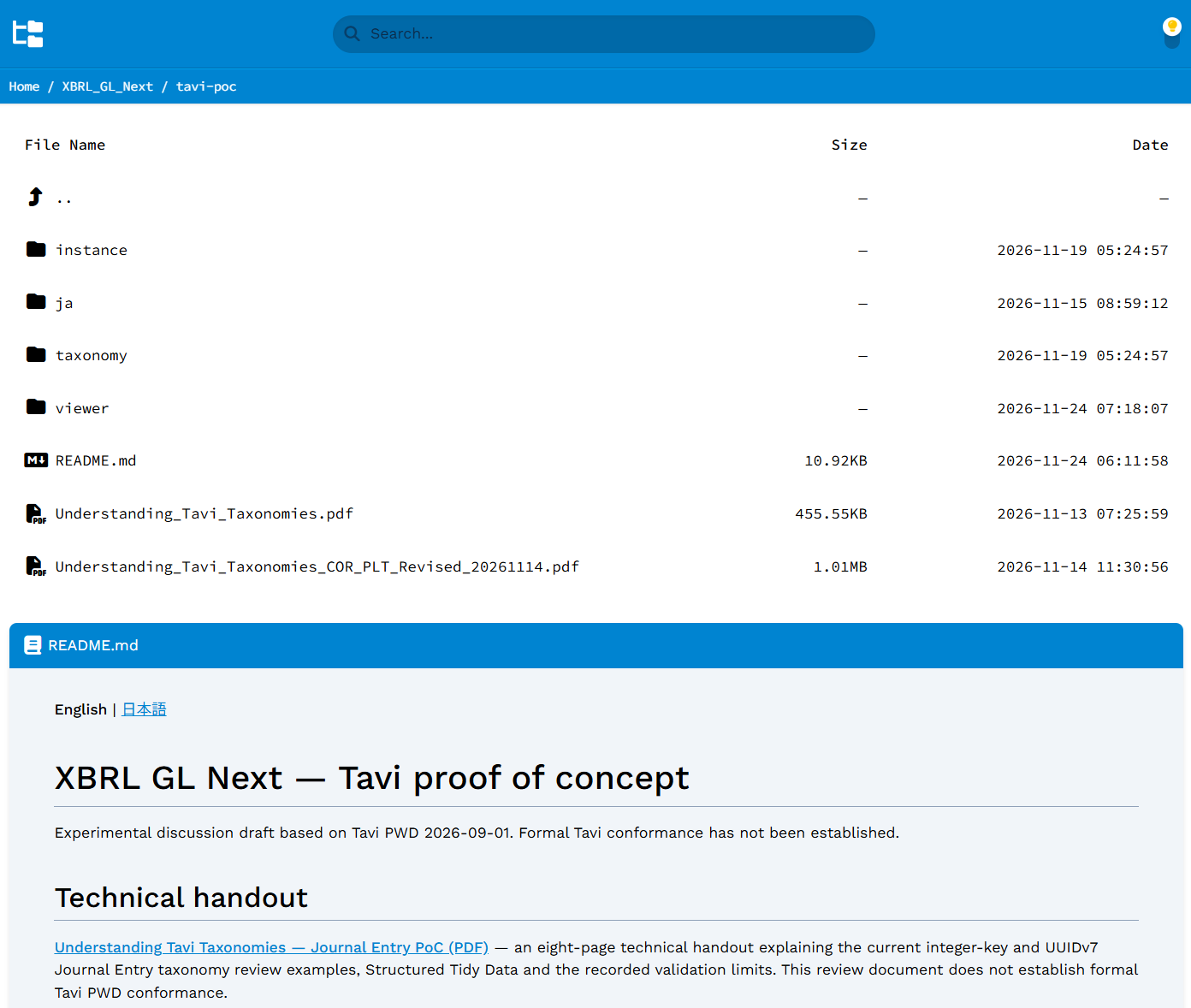
An introduction page and two Viewers are provided on EC2 so that general readers can explore the XBRL GL Next PoC without a GitHub user account.
7.4.1. Paint box and palette — separating COR and PLT
The EC2 introduction page’s README, shown as updated on 24 November 2026, introduces the COR/PLT replacement candidates dated 15 November. The standalone taxonomy structure of 2 November evolved into a structure separating reusable COR business Concepts from purpose-specific PLT (Palette) taxonomies. COR is the paint box and the purpose-specific HMD is the palette; PLT is an attempt to realise that palette as a Tavi taxonomy.
COR provides business Concepts and a candidate repeating Account structure. PLT imports COR and constructs the Cubes, Occurrence Dimensions, Domain Networks and Presentation Networks for the journal. The introduction page lists the following files.
| Component | Integer-key version | UUIDv7-key version |
|---|---|---|
|
COR Taxonomy |
||
|
PLT Taxonomy |
||
|
Instance Module |
||
|
Structured Tidy Data CSV |
||
According to the README, both CSV versions have 18 columns and seven data rows, and the Table Template is defined in the Instance Module. The Instance Module specifies the correspondence between taxonomy and CSV, separating business semantic definitions from the Binding to the physical representation of the data. The above is the structure of the earlier 18-column version listed on the introduction page. The 20-column version discussed below is described on the basis of actual Viewer displays.
7.4.2. Tavi Viewer — inspecting the PoC definitions
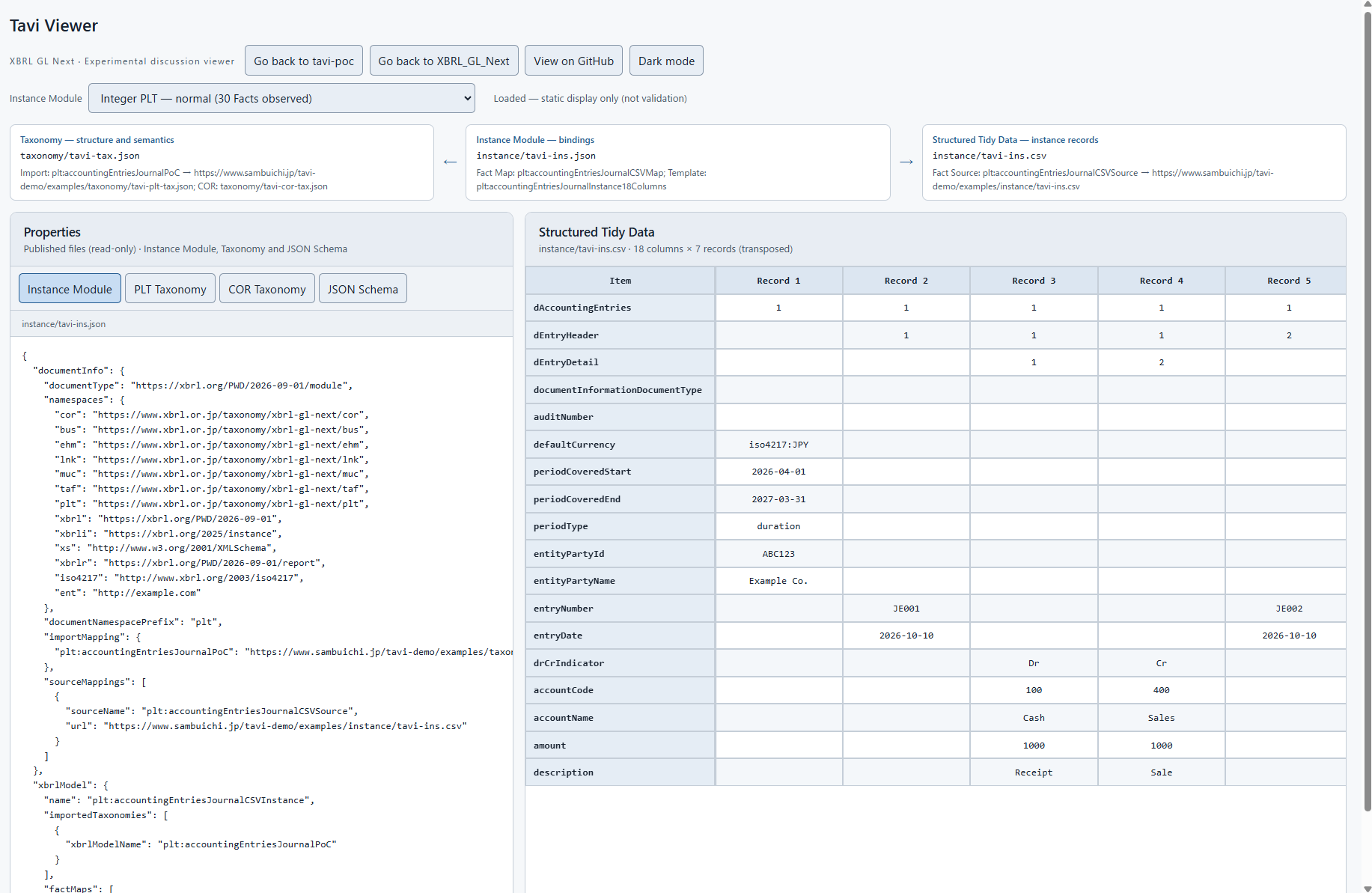
Tavi Viewer is a read-only viewer for inspecting the correspondence between the definitions created in the PoC and Structured Tidy Data. The screen inspected on 25 November 2026 offered 13 selections: an integer version, a UUIDv7 version, an example of the tested configuration, a 20-column version including VAT, and nine negative-test examples. The Properties pane on the left has tabs for the Instance Module, PLT Taxonomy, COR Taxonomy and JSON Schema; the right-hand pane displays the transposed CSV.
7.4.3. Model Viewer — exploring the PoC using XII’s demonstration tool
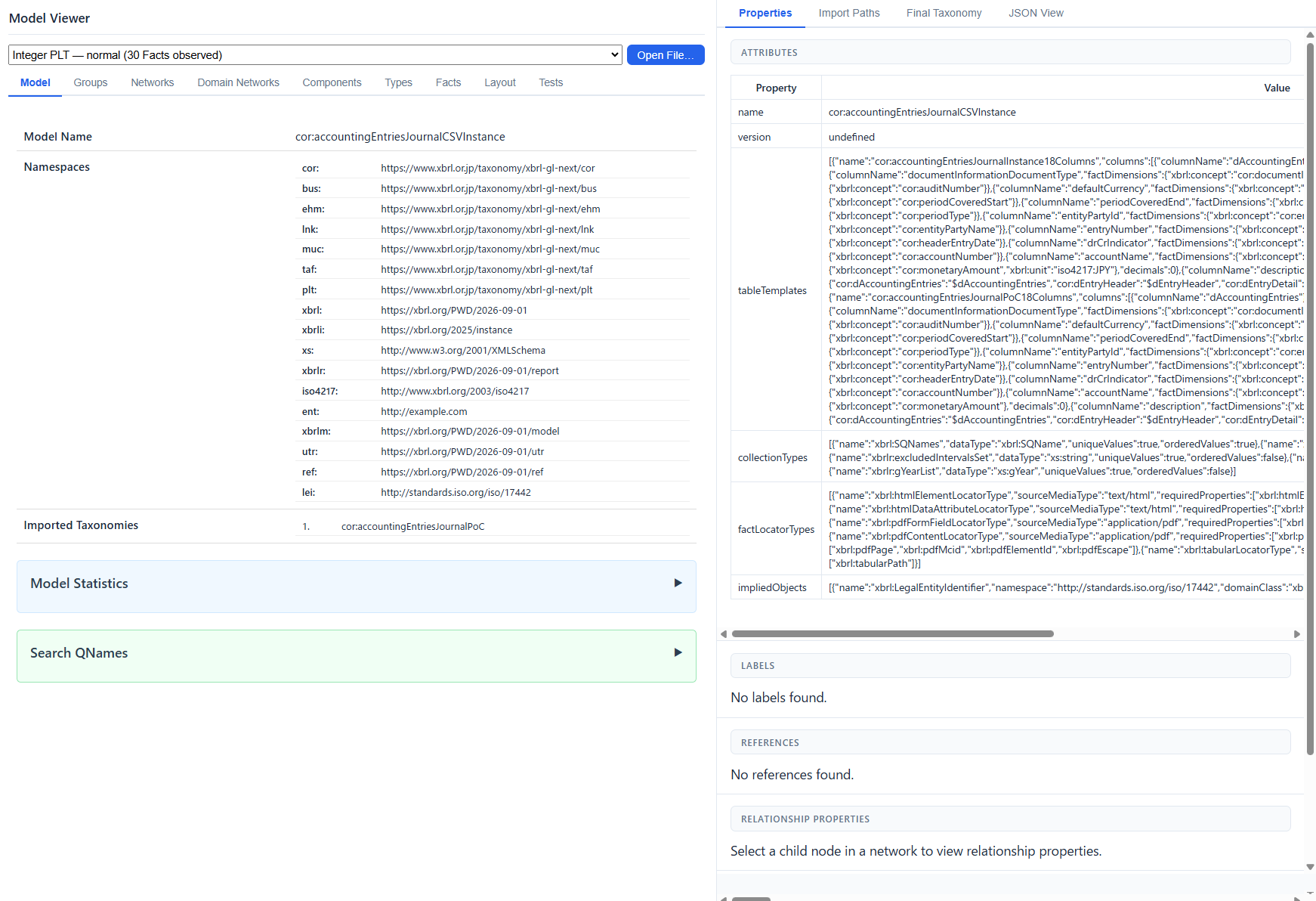
Model Viewer is based on the demonstration page published by XBRL International (XII) alongside the Project Tavi PWD, with its subject changed to the XBRL GL Next PoC definitions and data. It offers the same 13 selections as Tavi Viewer and has Model, Groups, Networks, Domain Networks, Components, Types, Facts, Layout and Tests tabs. Readers can examine the PoC semantic definitions and generated Facts in a browser without needing a GitHub account.
The introduction page also links to the Annotated Source Viewer. The original demonstration is the XII Project Tavi Official Demo. [11]
7.4.4. The 20-column version for VAT-inclusive sales and purchases
Selecting VAT sales & purchases — 20 columns in both Viewers allows readers to examine compound journal entries with total debits and total credits in EntryHeader. The following file structure was displayed during the screen inspection on 25 November 2026.
| Component | File |
|---|---|
|
COR Taxonomy |
|
|
PLT Taxonomy |
|
|
Instance Module |
|
|
Structured Tidy Data |
The Instance Module’s importMapping references the PLT Taxonomy, and sourceMappings references the CSV. factMaps, factSources and tableTemplates define the correspondence between columns and Facts. The Table Template is plt:accountingEntriesJournalInstance20Columns. totalDebit and totalCredit correspond to cor:totalDebits and cor:totalCredits respectively, with Unit iso4217:JPY and decimals of 0. The debit/credit indicator is retained independently of the amount as cor:debitCreditIndicator.
| Item | Root | H1 | D1 | D2 | D3 | H2 | D1 | D2 | D3 |
|---|---|---|---|---|---|---|---|---|---|
|
dAccountingEntries |
1 |
1 |
1 |
1 |
1 |
1 |
1 |
1 |
1 |
|
dEntryHeader |
1 |
1 |
1 |
1 |
2 |
2 |
2 |
2 |
|
|
dEntryDetail |
1 |
2 |
3 |
1 |
2 |
3 |
|||
|
entryNumber |
JE001 |
JE002 |
|||||||
|
entryDate |
2026-10-10 |
2026-10-11 |
|||||||
|
totalDebit |
11000 |
5500 |
|||||||
|
totalCredit |
11000 |
5500 |
|||||||
|
drCrIndicator |
Dr |
Cr |
Cr |
Dr |
Dr |
Cr |
|||
|
accountCode |
1100 |
4100 |
2300 |
5100 |
1300 |
2100 |
|||
|
amount |
11000 |
10000 |
1000 |
5000 |
500 |
5500 |
This table extracts selected items from the actual Tavi Viewer display; the original CSV has 20 columns and nine data rows. Journal entry JE001 records accounts receivable of 11000, sales of 10000 and output VAT payable of 1000. JE002 records purchases of 5000, input VAT recoverable of 500 and accounts payable of 5500. Header debit and credit totals agree with the corresponding Detail amounts aggregated separately by debit and credit.
| Item | Count |
|---|---|
|
Concepts |
23 |
|
Cubes |
7 |
|
Dimensions |
12 |
|
Domain Networks |
8 |
|
Networks |
5 |
|
Facts |
44 |
|
Fact Maps |
4 |
|
Fact Sources |
1 |
The seven Cubes comprise four COR Cubes corresponding to AccountingEntries, EntryHeader, EntryDetail and Account, and three journal PLT Cubes. The COR hierarchical Network retains the Account Class, whereas the PLT Presentation Network places account numbers and descriptions as attributes of the journal line. This provides a concrete example of a purpose-specific palette reusing common semantics.
The 44 Facts comprise six Root items, four items in each of two Headers, and five items in each of six Details. Both Viewer displays were checked for the Instance Module model name, PLT Import URL, Fact Source name, CSV reference URL and 20-column mapping. The 44 distinct Fact Position names displayed in Model Viewer correspond to the non-empty semantic items in the Tavi Viewer CSV. This does not establish byte identity of the individual distributed files or independent verification of every Fact value and Dimension.
The 20-column version is a publicly available example added alongside the existing illustrative version with 18 columns, seven records and 30 Facts. It does not imply withdrawal of the earlier example. Readers can select the same 20-column version in both Viewers and compare definitions, data and Fact Positions. [12], [13]
7.4.5. Published validation records and the scope of the current inspection
The EC2 introduction page records a normal integer PLT case reported on 14 November 2026 as producing 30 Facts and zero errors. It also lists the following negative-test results.
| Case | Subject | Previously reported result |
|---|---|---|
|
E01 |
Non-integer Root key |
6 expected errors |
|
E02 |
Non-integer Header key |
2 expected errors |
|
E03 |
Non-integer Detail key |
5 expected errors |
|
E04 |
Invalid date |
1 expected error |
|
E05 |
Invalid amount |
1 expected error |
|
E07 |
Invalid QName |
Expected error not detected; HOLD |
|
E08 |
Missing ancestor Dimension |
5 expected errors |
|
E09A |
Unmapped CSV column |
30 Facts, no error reported; distinguished from a normal-case PASS |
|
E09B |
Undefined Dimension |
Expected QName / Fact-space errors |
The E08 record concerns detection of a missing ancestor Dimension, not proof of the existence of an arbitrary parent record.
For the article revision of 25 November 2026, the EC2 introduction page README and both Viewers’ initial displays and displays after selection of the 20-column version were inspected on a read-only basis. The 20-column version displayed 44 Facts and the Binding described above. No result rows were displayed in the Tests results table, and the total error count remains unconfirmed. The initial integer displays differed in model name and Import target between the two Viewers and were therefore not judged to use identical definitions. Negative tests were not rerun, all distributed files were not compared, and formal Tavi PWD conformance was not established. The above results from 14 November are existing records.
The introduction page lists the technical handout Understanding Tavi Taxonomies — COR/PLT Journal Entry PoC (14 November 2026).
7.5. What parent keys enable — selection and aggregation in the LedgerExplorer approach
When Root, Header and Detail occurrences are recorded as R1/H1/D1, the same D1 can occur under another Header. The important point is that a set of keys including ancestors, rather than a single detail identifier, identifies the record occurrence.
The envisaged use of Structured Tidy Data does not rely on SQL JOINs across multiple tables. Instead, as in LedgerExplorer, a single Structured Tidy Data CSV is read into a DataFrame or similar structure, and records are selected and aggregated using column conditions. The one-to-one correspondence between HMD and Structured Tidy Data CSV, together with the ancestor Occurrence Dimensions retained in each row, allows the parent Scope to be specified without reconstructing joins across multiple hierarchical tables.
For example, read the CSV into a DataFrame and select only amount lines belonging to EntryHeader H1 in AccountingEntries R1. The following Pandas example illustrates the processing approach.
import pandas as pd
df = pd.read_csv("structured_data.csv", dtype={
    "dAccountingEntries": "string",
    "dEntryHeader": "string",
    "dEntryDetail": "string",
})
selected = df.loc[
    df["dAccountingEntries"].eq("R1")
    & df["dEntryHeader"].eq("H1")
    & df["dEntryDetail"].notna()
    & df["amount"].notna(),
    ["dAccountingEntries", "dEntryHeader", "dEntryDetail", "amount"]
]
Similarly, line records can be selected by debit/credit indicator and aggregated by journal entry using combinations of ancestor Dimensions. Debits (Dr) and credits (Cr) remain separate; their netted sum is not unconditionally treated as a balance.
details = df.loc[
    df["dEntryDetail"].notna()
    & df["amount"].notna()
    & df["drCrIndicator"].isin(["Dr", "Cr"])
].copy()
details["amount"] = pd.to_numeric(details["amount"], errors="raise")
journal_totals = (
    details.groupby(
        ["dAccountingEntries", "dEntryHeader", "drCrIndicator"],
        dropna=False,
    )["amount"]
    .sum()
    .unstack("drCrIndicator", fill_value=0)
)
This is an example of using CSV column selection, filtering, grouping and aggregation. The LedgerExplorer approach connects this processing with viewing and analysing journals and ledgers. Column names in the example code are illustrative; actual use must follow the formal column definitions of the corresponding HMD and Structured Tidy Data CSV. Aggregation of amounts requires semantic consistency not only of debit/credit but also of currency, unit, Concept and applicable period.
7.6. Why use UUIDv7? Revalidating historical business data
Integer Occurrence Dimensions can identify hierarchical record occurrences within one reporting dataset. XBRL GL Next, however, addresses more than transient reporting data.
Data generated by enterprise activities accumulates over long periods. Accounting audits and evaluations of internal controls require previously recorded accounting data to be revalidated against the underlying business data.
The purpose of using UUIDv7 is not merely to avoid occurrence-identifier collisions, but to identify business data persistently across different points in time, systems and datasets, whilst maintaining mutual reference relationships.
7.6.1. Linking accounting data with business data
Accounting entries do not arise in isolation. Business activities such as orders, despatches, receipts, invoices and payments take place, and their results are recorded in journals and ledgers.
Assigning UUIDv7 identifiers to these business data occurrences and recording the identifiers of related data as references allows transaction chains to be traced across individual dataset boundaries.
For example, a sales journal entry can reference the underlying invoice, the despatch record to which it relates, and ultimately the original order. Receipt of payment can identify the relevant invoice and allow settlement of accounts receivable to be checked.
| Business data | Related data | Revalidation example |
|---|---|---|
|
Order |
Despatch, receipt |
Reconcile ordered and fulfilled quantities |
|
Despatch |
Order, receipt, invoice |
Reconcile actual delivery and invoiced content |
|
Receipt |
Purchase order, despatch, purchase invoice |
Three-way matching of order, receipt/acceptance and invoice |
|
Invoice |
Order, despatch, receipt, journal entry |
Reconcile invoiced amounts with accounting records |
|
Payment |
Invoice, settlement, journal entry |
Verify clearing of receivables and payables |
|
Journal / Ledger |
Business records, original supporting documents |
Revalidate the basis of accounting records and aggregate results |
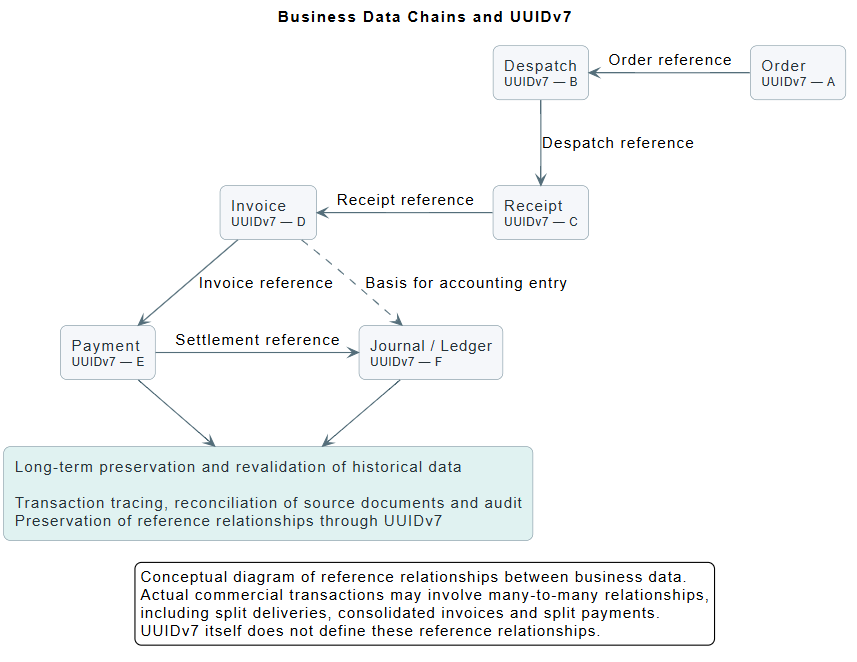
Note: In actual business activities, an order may involve multiple despatches, or several invoices may be settled together. Reference relationships are therefore not necessarily one-to-one and must be defined according to their business meaning.
7.6.2. Revalidating historical data
Persistent identification using UUIDv7 is valuable not only when data is generated but also when it is used in the future.
Even when accounting and business systems are upgraded, data saved at different times can be matched if the identifiers and reference relationships of historical data are preserved.
For example, records of orders, despatches, receipts, invoices and payments underlying historical journal entries may be retrieved and revalidated against the business rules, accounting policies, tax rates and calculation rules applicable at the time.
This provides a basis for tracing aggregated financial reports back to their underlying accounting records and ultimately to individual business activities.
UUIDv7 includes information derived from its generation timestamp and can thus also support chronological management. However, the UUID generation time is not the business transaction timestamp. When migrating historical data, the original transaction timestamp must be retained as an independent semantic item.
7.6.3. Occurrence identity within a hierarchy and references across hierarchies
Structured Tidy Data identifies record occurrences within a hierarchy by retaining ancestor Occurrence Dimensions.
By contrast, relationships between different business datasets are represented by recording the corresponding UUIDs as reference information.
The former concerns hierarchical containment relationships, such as Composition; the latter concerns references between independent business data. Distinguishing and combining these mechanisms allows hierarchical data structures and relationships across enterprise activities to be represented.
7.6.4. A foundation for long-term audit trails
UUIDv7 does not replace business order numbers, invoice numbers or voucher numbers. These business identifiers and UUIDs identifying data occurrences perform different roles.
The same data occurrence must also retain the same identifier. Assigning a new UUID every time data is converted, copied or migrated to another system would destroy historical reference relationships.
Adopting UUIDv7 alone does not guarantee uniqueness, authenticity, integrity or referential integrity of data. Persistent identifier management, checking that reference targets exist, retaining change histories, and version management of the applicable semantic models and validation rules are also required.
With such mechanisms in place, XBRL GL Next has the potential to go beyond accounting data standardisation and provide a foundation for preserving the history of enterprise activities in machine-readable form and revalidating it in the future.
This is also important when evaluating Tavi’s Record-based Data and Reference Data requirements from the perspective of long-term use of business data.
The current Journal Entry PoC demonstrates occurrence identification and hierarchical data representation that form the basis of this vision.
7.7. Cube and Dimension structures in OIM and Tavi
In the existing OIM taxonomy on GitHub, Class Scope is represented by relationships between Hypercubes, Typed Dimensions and Definition Networks. xbrldt:targetRole is used to transition to another Extended Link Role, constructing a mechanism for following each Class’s constraints. In the Tavi three-Cube PoC, by contrast, the Dimensions required for each Cube are specified directly in cubeDimensions.
| Class Scope | XBRL Dimensions approach | Direct specification in the Tavi PoC |
|---|---|---|
|
AccountingEntries |
Root Hypercube and Root Dimension |
|
|
EntryHeader |
Parent Root Scope and Header Dimension |
|
|
EntryDetail |
Parent Root/Header Scope and Detail Dimension |
|
This illustrates the expressive capability of Structured Tidy Data shared by OIM and Tavi. Nevertheless, targetRole handles transitions between Relationship Networks rather than specifying a Cube’s Dimensions itself. It is inaccurate to describe its entire meaning as simply replaced by cubeDimensions. The necessary comparison concerns whether the effective Dimension sets for each Concept and the resulting validity constraints of each Cube agree.
7.8. One-to-one correspondence between HMD and Structured Tidy Data
An HMD and its Structured Tidy Data CSV are treated as a semantic model and a report table conforming to that model. This does not mean that only one CSV file based on an HMD can ever exist, but rather that the applicable HMD definition can be identified unambiguously for the corresponding CSV under the model contract.
Consequently, replacing it with a CSV silently combining multiple HMDs for implementation convenience is outside the premise of this explanation. Nor does matching column counts alone establish conformance to the same HMD. Correspondence of Concepts, Datatypes, Multiplicities, occurrence Dimensions, Semantic Paths and related information is required.
7.8.1. No independent key for a Singular Class
Suppose a repeating InvoiceLine occurs under the Root, with exactly one ItemInformation beneath it and repeating ItemAttributes beneath that. Root, InvoiceLine and ItemAttributes require occurrence keys, whereas ItemInformation is uniquely determined by its parent InvoiceLine and does not require an independent occurrence key.
Invoice                 [root]   -> dInvoice
  InvoiceLine           [1..*]  -> dInvoiceLine
    ItemInformation     [1..1]  -> no new dimension
      ItemAttributes    [0..*]  -> dItemAttributes
This approach distinguishes the existence of a semantic Class hierarchy from the need for occurrence Dimensions. In the GL Next design, cubeDimensions specifies the necessary ancestor Dimensions. In the existing OIM Binding, the semantic hierarchy of Classes without independent keys is also retained through Primary Item Anchors, Hypercubes, Roles and related structures, and their attributes are placed in rows corresponding to the parent’s occurrence Scope.
8. Further possibilities — making the semantic model itself machine-readable
XBRL GL Next also envisages using Tavi not only for data but for the tables describing the models themselves.
Associating the meaning, data type, Label, Reference, relationships and constraints of each column with the Table Templates for FSM, BSM, LHM and HMD could support model validation and semantic traceability. The idea is to treat existing definitions and processing as more explicit and reusable machine-readable information.
The Binding Map is particularly important. A Semantic Path identifies a definition position in the HMD. Occurrence Dimension values including ancestors identify Class occurrences, and a semantic_path with Selectors identifies an occurrence of a specific semantic item. An XBRL Fact Position is identified by the Concept and applicable Dimension values. In existing XML standards such as XBRL Tuple, UBL, CII and SAF-T, XPath is combined with Selectors to select the target value.
The correspondence between these, namely the relationship between Semantic Path + Selector and XPath + Selector, forms the Binding Map. UADC (Universal Adapter for Data Conversion) is envisaged to use this information to convert between different standards. If the Binding Map itself could be defined in machine-readable form through Tavi References, Properties and Table Templates, it might become possible to trace correspondence between semantics, syntax and actual data consistently.
8.1. Describing Semantic Models as tables to make their meaning accessible
FSM, BSM, LHM and HMD are not merely four CSV files placed side by side. They are models with different roles, connected by prescribed processing rules. The FSM declares the meanings of Classes, Attributes and Associations. Specialisation resolves inheritance, additions, overrides and deletions to produce the BSM. Graph Walk traverses the BSM in the prescribed order, expanding Class and Property occurrences into the LHM. The reviewed HMD becomes the input to purpose-specific Taxonomy Binding.
Applying Tavi’s Table Template, Label, Reference, Property and Relationship concepts could provide a foundation for reading table columns as information with defined semantics and validation rules rather than mere strings.
| Column/item | Meaning | Envisaged machine processing |
|---|---|---|
|
|
Term identifying a Class |
Identify the Class definition |
|
|
Term identifying an Attribute |
Associate the attribute with its owner |
|
|
Role of the associated target |
Distinguish different Associations to the same Class |
|
|
Associated Class |
Resolve the reference target |
|
|
Permitted number of occurrences |
Validate the permitted range |
|
|
Source BSM row |
Trace processing results |
|
|
Definition position in the HMD hierarchy |
Common reference position for Binding |
|
|
Physical syntax name and location |
Trace Syntax Binding |
|
|
Domain of permitted values |
Semantic validation of values |
In such a model, Labels assist human understanding and References provide relevant standards, sources, clauses and semantic positions. For example, associating Semantic Paths with external-standard XPaths in References might facilitate traceability from model definitions to external data standards.
However, recording information in a Reference does not mean a processor necessarily executes it. Executable rules require contracts for evaluation targets, evaluation language, selection criteria, value conversion and error handling.
8.2. Roles of Table Templates and Table Constraints
Table Templates specify the correspondence between columns and Facts when projecting data into tables. Table Constraints help determine whether a table or report satisfies permitted structures and values. When treating FSM, BSM, LHM and HMD as semantic tables, we wish to consider not only column types and mandatory status, but also reference relationships between models.
The important point in semantic automation is not to eliminate processing rules themselves, but to make their subjects, prerequisites, outputs and traceability relationships accessible to machines. How far Tavi’s model definition functionality can be used for this purpose is a worthwhile subject for feasibility assessment.
8.3. A concrete Binding Map example
For the UBL taxable amount, for example, the target must be restricted not merely by the name TaxableAmount but also by the tax category, tax rate and other information of TaxSubtotal. The corresponding occurrence must also be identified on the HMD side. Definition positions and occurrence conditions must be distinguished, and namespaces, Selector evaluation context, code conversion and execution direction made explicit. Selectors expressed as XPath predicates are part of XPath and do not presuppose another undefined language.
8.4. Semantic automation and AI
AI approaches that infer meaning solely from labels and item descriptions are vulnerable to homonyms, synonyms and differences in tax categories or business conditions. If Semantic Paths, XPath, Selectors, source References, formal Datatypes and Value Domains can be accessed mechanically, AI can be used for candidate discovery and explanation and more readily connected to verifiable Bindings.
The aim is not to convert data merely because AI judged the conversion correct, but to verify semantic definitions and rules and preserve the basis for conversion. Tavi’s motivation to make taxonomies accessible to AI and the motivation to perform accurate semantic data conversion through systems such as UADC meet at this point.
9. Beyond journal entries — product passports
This framework is not restricted to accounting data. The Catena-X Battery Passport, for example, involves repeating and parent-child records for batteries, components, materials, measurements and lifecycle events. Structured Tidy Data based on Cubes and Dimensions could potentially support selection and aggregation by product, component or material.
Conformance with Catena-X’s formal semantic models, identifiers, access permissions and data exchange methods is a separate matter. The possibility of representation must not be confused with verified Catena-X conformance.
9.1. Considering the Catena-X Battery Passport as an application example
Journal entries provide an accessible example for understanding Structured Tidy Data, but its scope is not limited to accounting. The same approach could potentially be applied to uses such as the Catena-X Battery Passport, which handles relationships between products, components, materials, states and events.
For example, Battery could be the Root, Component and Material repeating Classes, and the Occurrence Dimensions of each Class combined. Specifying a Battery UUID would allow its subordinate components and materials to be selected; including a Component UUID would restrict the scope to a component. Measurements requiring a Period or Unit could also be identified as Facts using the same Cube/Dimension approach.
| Scope | Required Occurrence Dimensions | Examples of accessible information |
|---|---|---|
|
Battery |
dBattery |
Basic product information |
|
Component |
dBattery, dComponent |
Component attributes and composition |
|
Material |
dBattery, dComponent, dMaterial |
Material name, quantity, mass and composition ratio |
|
Lifecycle Event |
dBattery, dEvent |
Repair, use, reuse and other events |
This potential application suggests that Tavi’s market need not be limited to financial reporting. This article does not, however, claim completion of a specific Catena-X-compatible Tavi taxonomy or regulatory conformance.
10. What has been achieved and what remains?
| Issue | What can be established from the September 2026 PWD / published PoC | Outstanding challenges |
|---|---|---|
|
Syntax-independent model |
JSON representation of Concepts, Dimensions, Cubes, Networks, Labels, References, etc. |
Finalising the specification and implementation interoperability |
|
Traditional reporting |
|
Full equivalence with existing XBRL 2.1 functionality within scope |
|
Events and details |
Specific proposed constraints for |
Validation of parent references, mandatory status and uniqueness |
|
Journal entries |
Proposed |
Calculation, reconciliation and native validation |
|
Record identification |
Examples of occurrence identification through Typed Dimensions and UUIDs |
Business PK/FK constraints and parent-child consistency |
|
Tabular representation |
Examples of Table Templates and Structured Tidy Data |
Demonstrating formal Tavi reporting conformance |
|
Migration and conversion |
Requirements demand backwards compatibility within scope |
Complete converters and published conversion limitations |
|
Semantic Binding |
Extension opportunities through References and Properties |
Standardisation and validation of executable Binding Maps |
11. Evaluation against the OIM Taxonomy Requirements
Based on the preceding discussion, Tavi’s value can be assessed along three axes: preservation of key existing XBRL functionality, representation and constraints of Record-based Data, and semantic model reuse. The requirements particularly relevant to this article are outlined below.
11.1. GEN: existing assets and scope of compatibility
REQ-GEN001 concerns alignment with the existing OIM Report Model, REQ-GEN002 requires equivalence with commonly used XBRL 2.1 functionality, and REQ-GEN004-BackwardsCompatibility concerns the convertibility of existing taxonomies within scope. These Requirements do not simply repeat the same issue.
For example, even if Tavi is designed to accommodate the existing OIM Fact model, there may not be a process faithfully converting every Network in a legacy taxonomy. Even if corresponding Networks can be represented, functional equivalence cannot be judged a complete PASS if Calculation 1.1-equivalent evaluation rules remain incomplete.
11.2. NFR: individual requirements for Record-based Data
| Requirement | What can be demonstrated concretely | What requires further specification or validation |
|---|---|---|
|
NFR001 Repeating records |
Identify records through Occurrence Dimensions including ancestors |
Semantic demonstration using an official Tavi processor |
|
NFR002 Mandatory fields |
Identify attribute items within each Class Scope |
Detect missing values for individual records |
|
NFR003 Uniqueness |
Define compound occurrence keys |
Uniqueness of arbitrary business fields |
|
NFR004 Primary Key |
Identify occurrences |
Business PK declaration and integrity |
|
NFR005 Foreign Key |
Retain parent occurrence scope |
Validate existence of arbitrary reference targets |
|
NFR006 Event |
Represent Event Key and attribute values |
Event-specific constraints |
|
NFR007 Reference |
Represent master records |
Reference-value versions and referential integrity |
|
NFR010 Position |
Represent a state at a particular time |
Point-in-time Scope and mandatory elements |
|
NFR011 Listing |
Represent lists of repeating items |
Confirm formal Listing constraints |
|
NFR012 Time-series |
Represent repeating values combined with Period |
Time-series semantics and validation |
These distinctions separate what can be represented from what can be validated. NFR001 can be explained through the XBRL GL Next design example. Column value constraints, unique keys and reference keys relevant to NFR002–005 can also be defined using existing xBRL-CSV Table Constraints, but this does not establish implementation of general Cube-level constraints in Tavi. Particularly for sparse hierarchical tables, mandatory status by row type and validation of parent-child relationships require individual examination.
11.3. RC: Required Cubes and Mandatory Fact Positions
RC001 concerns not only whether a Fact is permitted in a Cube but whether the required Fact actually exists. Even with mechanisms such as requiredCubes in the Tavi PWD, further examination is needed to determine whether all conditional Fact Positions, per-record mandatory requirements and compound-key-level mandatory requirements are generally guaranteed.
For example, where a Header occurrence has no Detail records, the constraint responsible for detecting this omission must be identified. A simple set of permitted Cube Dimensions does not necessarily derive every required occurrence-count condition.
11.4. TAB: tabular representation as a common implementation path
TAB001 concerns tabular reporting capability and its development direction. Structured Tidy Data illustrates how hierarchical records can be projected into rectangular tables using existing Cubes and Dimensions, providing a concrete example of this direction.
11.5. EXT / PROP / REL: machine-readable semantic reuse
Import, Property, Reference, Label and Relationship mechanisms are important for using a common model and selecting parts of it for particular purposes. Making semantic model definitions and Binding Maps from existing standards machine-readable is a direction that makes effective use of these functions.
However, applying third-party validation rules through Add-on Bundles is not equivalent to automatically converting every existing Formula rule. Tavi’s extension functionality and Formula compatibility should remain independent evaluation subjects.
11.6. Current status of the published PWD and implementation
| Category | What can be established in this review | Assessment |
|---|---|---|
|
Objectives and Requirements |
Aims to preserve key functionality, simplify and support Record-based Data |
VERIFIED FACT |
|
Cube / Dimension / Network |
A JSON model exists in the PWD |
VERIFIED FACT |
|
COR/PLT and Structured Tidy Data |
20-column version observed in both EC2 Viewers: 23 Concepts, 7 Cubes, 20 columns and 9 records, 44 Facts |
VERIFIED FACT (screen display) |
|
Integer PLT normal and negative cases |
30 Facts and zero errors on 14 November, with negative-test results |
Existing validation records |
|
20-column version in EC2 Viewers |
Confirmed selected displays, model names, Import and CSV reference targets, Fact Position names and debit/credit aggregation from displayed values |
VERIFIED FACT (screen inspection) |
|
Diagnostics and identity of distributed files |
Total error count, negative-test reruns and full comparison of individual files unconfirmed |
UNRESOLVED |
|
Full regression for 15 November replacement candidates |
Completion cannot be confirmed |
UNRESOLVED |
|
Formal |
Published PoC uses a general three-Cube model |
UNRESOLVED |
|
Complete successor to Calculation 1.1 |
Identified as future work in the PWD |
UNRESOLVED |
|
General PK/FK validation |
Occurrence identification examples exist, but all constraints remain unconfirmed |
UNRESOLVED |
|
Comprehensive conversion of XBRL 2.1 assets |
Scope of requirements differs from conversion guarantees |
UNRESOLVED |
|
Production adoption of Tavi |
Cannot be inferred from regulatory adoption of xBRL-CSV |
UNRESOLVED |
This assessment is based on the September 2026 PWD, existing evidence on the public EC2 introduction page, and inspection of the selected displays in both Viewers on 25 November 2026. Full comparison of distributed files, full comparison against project authorities, renewed confirmation of diagnostics and new Conformance Suite tests were not performed.
12. Conclusion — handling data and meaning on the same foundation
Tavi was not created because XBRL had come to the end of its useful life. Rather, its purpose is to open the concept of giving data meaning, established by XBRL over many years, to more fields and users.
Hierarchical business data can already be represented as Structured Tidy Data using existing XBRL 2.1, XBRL Dimensions and xBRL-CSV. Tavi does not make this capability possible for the first time. Practical xBRL-CSV use has demonstrated how multidimensional Facts can be handled in tabular form. Tavi seeks to redesign the underlying taxonomy so that general software and AI can use it more easily. XBRL GL Next’s Structured Tidy Data illustrates this direction through hierarchical accounting journal records.
It is equally important to distinguish objectives from achievements. The September 2026 PWD is a starting point for discussion, with outstanding challenges concerning Calculation, Primary and Foreign Keys, mandatory records and conversion of existing assets within Tavi’s semantic model. These challenges must be distinguished from the validation already possible through existing xBRL-CSV Table Constraints.
The next question is not merely whether XML Tuples can be replaced by JSON. It is whether semantic models, Cubes and Dimensions, specific data occurrences and Bindings to existing standards can be linked on the same machine-readable foundation. Here lies the potential to extend beyond financial reporting to journal entries, business events, audit data and product passports.
References
-
[1] XBRL International, XBRL Taxonomy Model Requirements 1.0, 2025-12-17
https://www.xbrl.org/REQ/oim-taxonomy-requirements/REQ-2025-12-17/oim-taxonomy-requirements-2025-12-17.html -
[2] XBRL International, Project Tavi 1.0 — Public Working Draft, 2026-09-01
https://www.xbrl.org/Specification/tavi/PWD-2026-09-01/tavi-PWD-2026-09-01.html -
[3] XBRL International, Project Tavi — Specifications and Supporting Documents
https://specifications.xbrl.org/work-product-index-open-information-model-tavi.html -
[4] XBRL International, Introducing OIM Taxonomy: An Easier, Faster, More Powerful XBRL Experience, 2026-03-03
https://www.xbrl.org/introducing-oim-taxonomy-an-easier-faster-more-powerful-xbrl-experience/ -
[5] XBRL International, Next Generation XBRL — The First Public Working Draft, 2026-09-02
https://www.xbrl.org/next-generation-xbrl-the-first-public-working-draft/ -
[6] XBRL International, Some Next Generation XBRL Thoughts, 2026-11-01
https://www.xbrl.org/news/some-next-generation-xbrl-thoughts/ -
[7] European Banking Authority (EBA), Reporting Framework 4.2 — CSV Adoption Policy
https://www.eba.europa.eu/risk-and-data-analysis/reporting-frameworks/reporting-framework-42 -
[8] XBRL International, xBRL-CSV Table Constraints 1.0 — Recommendation, 2026-09-10
https://www.xbrl.org/Specification/table-constraints/REC-2026-09-10/table-constraints-REC-2026-09-10.html -
[9] XBRL GL Next, Public Tavi PoC introduction page on EC2 (accessed 2026-11-25)
https://www.sambuichi.jp/docs/?dir=XBRL_GL_Next/tavi-poc -
[10] XBRL GL Next, GitHub Repository — Taxonomy Framework and PoC
https://github.com/pontsoleil/XBRL_GL_Next -
[11] XBRL International, Project Tavi Official Demo (PWD 2026-09-01)
https://www.xbrl.org/Specification/tavi/PWD-2026-09-01/demo/tavi-demo-2026-09-01/ -
[12] XBRL GL Next, Public Tavi Viewer on EC2 (screen inspected 2026-11-25)
https://www.sambuichi.jp/docs/?file=XBRL_GL_Next/tavi-poc/viewer/tavi-viewer.html -
[13] XBRL GL Next, Public Model Viewer on EC2 (screen inspected 2026-11-25)
https://www.sambuichi.jp/tavi-demo/viewer/model-viewer.html
- 1. From a financial reporting standard to a standard for diverse business data
- 2. What has the market been asking for?
- 3. Is it fully compatible? Not unconditionally
- 4. How far has the PWD progressed?
- 5. The direction indicated by four representative Cube Types
- 6. Why not adopt Tuples directly in JSON?
- 7. XBRL GL Next — handling the world of records through Cubes and Dimensions
- 7.1. The semantic model precedes the table structure
- 7.2. First consider hierarchical journal entries in three tables
- 7.3. Representing three tables in a single Structured Tidy Data CSV
- 7.4. A public PoC that general readers can explore in their browsers
- 7.5. What parent keys enable — selection and aggregation in the LedgerExplorer approach
- 7.6. Why use UUIDv7? Revalidating historical business data
- 7.7. Cube and Dimension structures in OIM and Tavi
- 7.8. One-to-one correspondence between HMD and Structured Tidy Data
- 8. Further possibilities — making the semantic model itself machine-readable
- 9. Beyond journal entries — product passports
- 10. What has been achieved and what remains?
- 11. Evaluation against the OIM Taxonomy Requirements
- 11.1. GEN: existing assets and scope of compatibility
- 11.2. NFR: individual requirements for Record-based Data
- 11.3. RC: Required Cubes and Mandatory Fact Positions
- 11.4. TAB: tabular representation as a common implementation path
- 11.5. EXT / PROP / REL: machine-readable semantic reuse
- 11.6. Current status of the published PWD and implementation
- 12. Conclusion — handling data and meaning on the same foundation
- References


Leave a Reply